

Introduction: Why 90% of traders blow their deposit?
You've heard it a hundred times: "Keep a trading journal!" You tried. But you quit quickly. Because entering trades manually is boring and time‑consuming.
Then smart services appear on the market. They say: "Forget manual entry! Connect API — and trades will be pulled automatically in 5 seconds!"
Sounds like a dream, right?
Wrong.
Let me tell you the scary secret of marketing. Those services that sell you automatic API import — they are actually selling you the illusion of progress. They think you are a robot. That you only need numbers.
But you are human. And your main problem in trading is not data entry speed. Your main problem is that you don't see your mistakes.
And the only way to see them is to enter every trade manually:
- With your fingers
- With your keyboard
- With your brain
Part 1. What does automatic import give you? (Spoiler: almost nothing)
Imagine. You took 15 scalping trades today. Plus/minus. In the evening you click "Sync with broker" — and voila! All trades are nicely arranged on the shelves.
You look at the charts. Win rate 55%. Profit factor 1.1. "Not bad," you think. "I'll try again tomorrow."
Question: did you become a better trader after that?
Answer: no. You just looked at numbers. But you didn't feel your mistakes.
When you look at an automatically imported order, your brain sees:
Automatically: "BUY EURUSD, +23 pips".
Manually: "I entered on a breakout. But I got in too early. Then price went down, I was in drawdown for 15 minutes, my palms got sweaty, I wanted to close the loss but held on. And only then price went up."
See the difference? In the first case — statistics. In the second — a lesson you will remember for life.
Part 2. Why manual entry is the magic of awareness?
When you enter a trade into your journal yourself, 5 important things happen:
- You capture emotions
Do you remember what you felt at the moment of entry? Fear? Greed? Confidence? Automatic import doesn't know that. - You notice patterns of mistakes
After a week of manual entry, you'll suddenly see: "Oh, I keep opening trades on Monday morning against the trend!" API won't show you that. - You memorize your best trades
When you rewrite a winning order manually, you relive the moment of success. This reinforces correct behavior. - You build neural connections
Scientific fact: motor memory + visual perception = deep learning. When you type trade parameters, your brain literally "wires in" the right strategy. - You start respecting every trade
Automatic import devalues your actions: "Whatever, just pressed a button." Manual entry tells your brain: "This is important. I'm spending my time on it. That means I must trade consciously."
Part 3. But what about scalping? 40 orders a day — that's crazy!
Yes, you're right. If you're a scalper and open 30–40 positions a day — entering each one manually is physically hard. So let me ask you an honest question:
Why do you trade so much?
The experience of thousands of traders proves: quality always beats quantity. One well‑thought-out trade with a risk/reward ratio of 1:3 will bring you more money and peace than 40 chaotic scalps.
Manual entry automatically filters out junk trades. You'll think twice before opening that 41st order of the day if you know you'll have to write it down in the evening.
And you know what? That's a plus, not a minus. Your journal makes you trade carefully and selectively. And that saves your deposit.
Part 4. "Smart Notes" — the secret weapon of MyTraderDiary
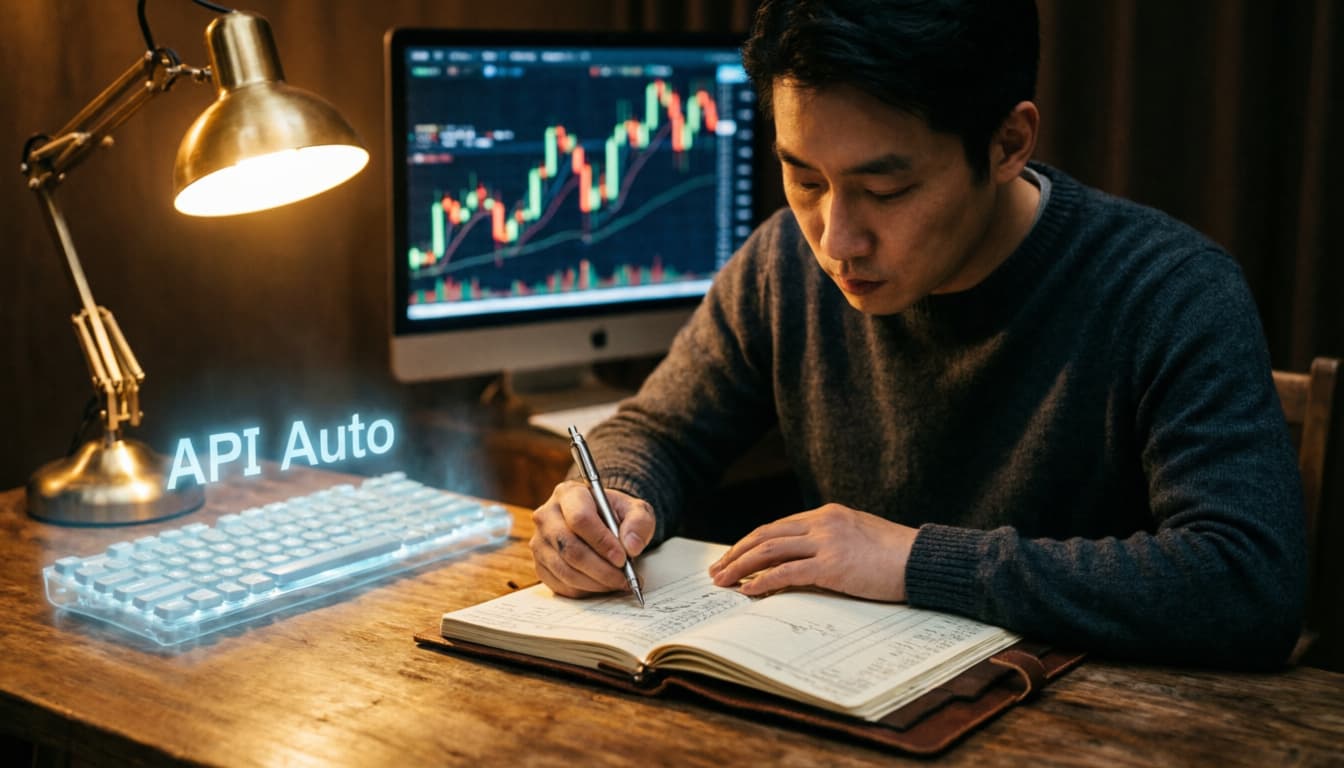
Just recording trades is already good. But I want to give you more.
MyTraderDiary has a feature that competitors with their dumb APIs don't have. It's called "Smart Notes".
What is it?
It's a place where you don't just record numbers. You have a dialogue with the market.
Example from a real trader's life:
"April 13, 16:20. I see that GBP/USD has been hovering around 1.3450 for three hours now. Last time there was such a lull, the breakout happened in the direction of inflation news. I'm placing a pending order to break upward. In my notes I write: 'Waiting for CPI data at 16:30.'"
A week later you open your Smart Notes and see:
"Aha! Every time before news, the market freezes for 2-3 hours. And the breakout always goes in the direction of the data release. This is my pattern!"
You've just discovered your own trading system. For free. Without $2000 courses. Simply because you kept notes.
How to use Smart Notes as a cheat sheet?
Here are 3 powerful scenarios:
| Scenario | How to use |
|---|---|
| Sentiment analysis | Before a trade, write: "Bullish / Bearish / Neutral". Then compare with the result. Identify your cognitive bias. |
| News tracking | Write down what the news background was before your best and worst trades. You'll see correlations. |
| Weather / time patterns | Yes, seriously. One trader noticed he only lost money on Tuesday afternoons. Turned out — he was just sleepy after lunch. Started drinking coffee — profit went up. |
Part 5. A message to traders (and everyone who wants to actually make money)
I know that trading is becoming very popular. And I see many of you looking for the "easy path". Automated robots. Signal channels. API import to "do nothing".
Let me tell you as an older brother (or sister): easy money doesn't exist.
If you're not ready to enter your trades manually, if you're not ready to spend 10–15 minutes each evening on analysis — you're not ready for trading. Go to the stock market with professionals. Or open a bank deposit with interest.
But if you truly want to learn, if you're ready to use your brain — then manual entry and Smart Notes will become your main tools.
Why?
Because the market is not mathematics. It's psychology. It's discipline. It's you and your decisions.
No API will write in your journal why you entered 5 minutes before the signal. No API will notice that your best trades only happen when you've had enough sleep. No API will understand that you're afraid to hold profits and close too early.
Only you can do that. By writing down every trade manually.
Conclusion: API is for robots, manual entry is for humans
I'm not saying API is evil. If you have 100 trades a day and you're a high-frequency algorithmic trader — yes, use API. But you wouldn't be reading this article if you were a robot.
You are human. You make mistakes. You learn. You grow.
And your journal should help you grow, not just show dry numbers.
MyTraderDiary was created for humans. Here you enter trades manually. Here you write Smart Notes. Here you see your progress and your mistakes.
It's not "inconvenient". It's priceless!
Start today. Don't look for easy paths. Your future profit will thank you.
👉 [Try MyTraderDiary free for 14 days. No card required. No obligations.]
P.S. Bonus — a question you should ask yourself right now
Look at your last losing month.
Now answer honestly:
"If I had manually written down every trade and re‑read my Smart Notes every week — would I have still lost that money, or would I have found a way to stop in time?"
I know the answer. And so do you.
Don't fool yourself. Turn on awareness.