
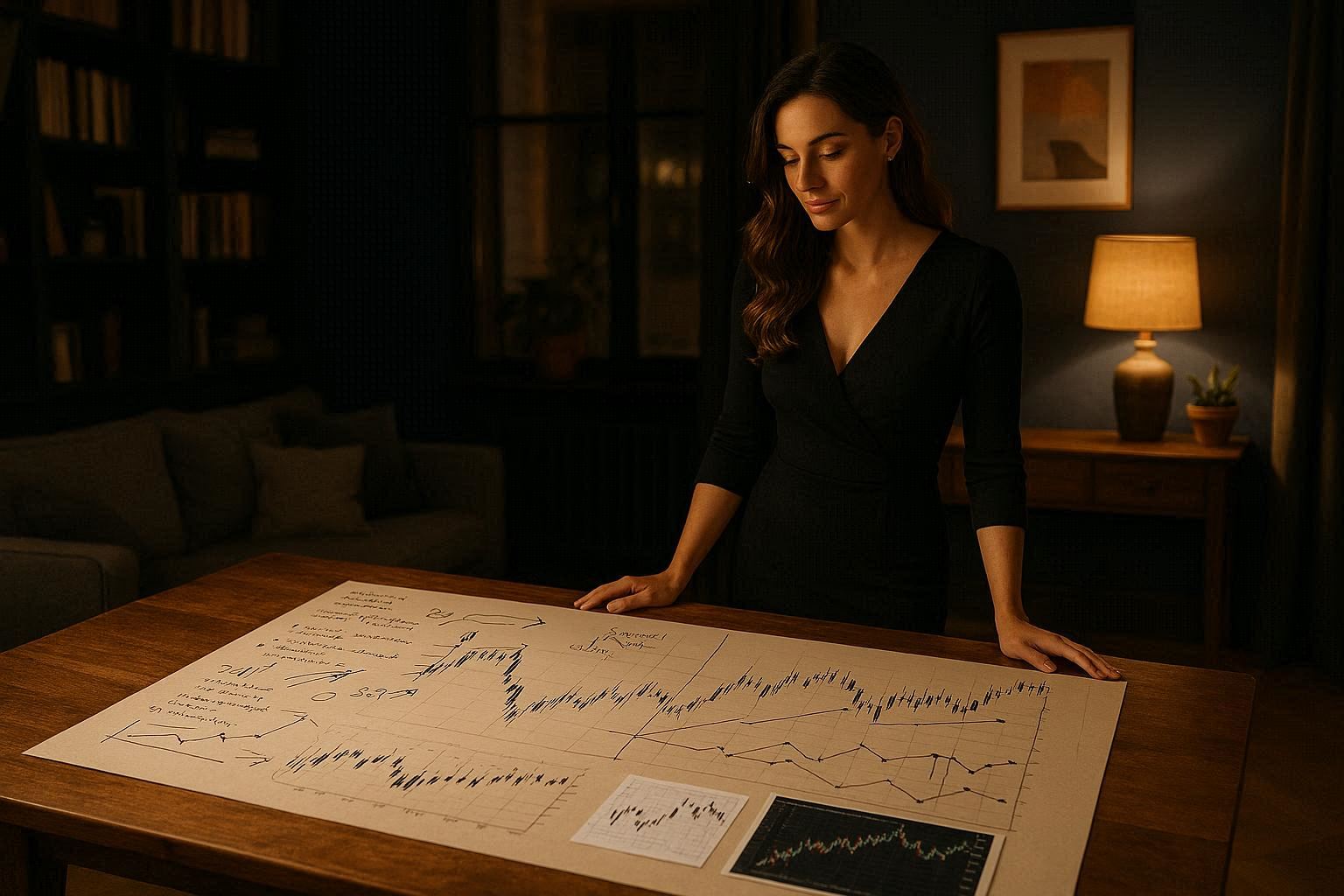
Why does a trader need a journal? 4 reasons to keep a trading journal: trading system statistics, discipline, error analysis, and emotional control. Turn trading from gambling into a business.
Many beginners think a journal is boring paperwork for "nerds." But in reality, it is the most powerful growth tool. It is a mirror that shows your true face: a disciplined pro or an emotional gambler.
Without a journal, a trader is like a cook preparing food with their eyes closed. The ingredients are on the table, hands are in place, but the taste is unpredictable every time.
Let's break down 4 main reasons to keep a journal and 3 specific steps to make it work.
Part 1. WHY? (Deep Analysis)
1. Trading System Statistics — Stop Guessing
Without statistics, you know nothing about your strategy.
- What you get: win rate, maximum drawdown, average loss per trade.
- Hard truth: Without a journal, your trading system is a fantasy. With a journal, it is an asset.
2. Discipline — The Battle With Yourself
FOMO, averaging down a losing trade, moving a stop loss — all of this gets recorded.
- How it works: a column "Did I break the rules? Yes/No". After a week, you will feel ashamed.
- Secret: Discipline is born from an accounting system. Write — realize — fix.
3. Error Analysis — Stop Stepping on the Same Rake
An error not written down in a journal will repeat endlessly.
- Classification: technical (wrong stop loss) and psychological (averaging down out of fear).
- Result: you will stop blaming the market. You will start blaming (and fixing) yourself.
4. Emotional Compass — Understand When Your Brain Breaks
Euphoria from profits is replaced by rage from losses.
- Method: a mood scale from 1 to 10 before each trade.
- Safeguard rule: mood above 7 or below 3 — do not trade, only watch.
Part 2. HOW? (Your Practical Block)
A journal is valuable as reprocessing. Every evening (or once a week) do a post-mortem:
- "Hero of the Day" — the best trade. Why did it work? (Patience? Clear signal?)
- "Shame of the Day" — the worst loss. Why? (Risk rule broken? Entered without a signal?)
- P&L Chart — look at your balance curve. If it goes straight down — change your strategy. If it twitches like a hummingbird's heart — work on your psychology.
Part 3. READY-MADE TEMPLATE (What Was Missing)
Minimum set of columns for any spreadsheet (Excel / Google Sheets):
| Date | Asset | Direction | Entry Price | Exit Price | Result | Entry Reason | Error / Emotion |
|---|---|---|---|---|---|---|---|
| 12.05 | BTC/USD | Long | 34500 | 34700 | +$200 | Breakout of level | Fear, closed too early |
If you have few trades (swing trading / investing) — add a "Chart Screenshot" column. The eye sees what words cannot describe.
Part 4. CHECKLIST FOR THE LAZY (The Minimal Viable Journal)
If you really don't want to write much — answer at least 3 questions in writing after each trade:
- Why did I enter? (Was there a signal OR did it just feel right?)
- Where was my stop loss? (It existed OR I was hoping for a miracle?)
- What am I feeling? (Calm OR greed / fear?)
These three questions save more money than any complex journal.
Bonus. How Do You Know You Are Keeping a Journal CORRECTLY?
You are keeping it correctly if after a month you can calmly answer:
- Which currency, coin (stock) brings me the most losses? (Maybe it's time to forget it.)
- Do I lose money in the first half of the day or in the evening? (Maybe I should sleep until noon.)
- Does my "intuition" work better than technical analysis, or the other way around?
Conclusion: What a Journal Provides as a Business Tool
| Without a Journal | With a Journal |
|---|---|
| "I think my strategy works" | "52% win rate, mathematical expectation +0.5%" |
| "I'm just unlucky" | "I break risk rules in 30% of trades — eliminating this" |
| "I made the same mistake again but don't remember why" | "In six months I averaged down 15 times — stop loss is everything" |
| Chaotic trading | Systematic business |
Summary for the "One-Person Orchestra"
Dear friend, if you want to be not a toy of the market but its master — start today. No fancy apps are needed.
Open the Smart Notes page at Mytraderdiary.com, and enter your last trade, even if it was terrible.
A professional trader differs from an amateur in exactly one way — having a journal. An amateur has an "opinion." A professional has numbers.
Start keeping a journal today. In a month, you will be horrified at how you could trade blindly.
Your profit over time is just a printout of your journal. No embellishment.
Wishing you successful profits and a cool head!